AI News: How to Verify Announcements and Claims
AI news moves quickly, and a compelling headline can reach readers before the underlying details are clear. A useful news article explains what happened, when it happened, which product it affects, and what remains uncertain. This guide describes a verification process for model announcements, provider changes, hardware launches, and research claims. It helps readers separate a confirmed development from an interpretation or an untested promise.
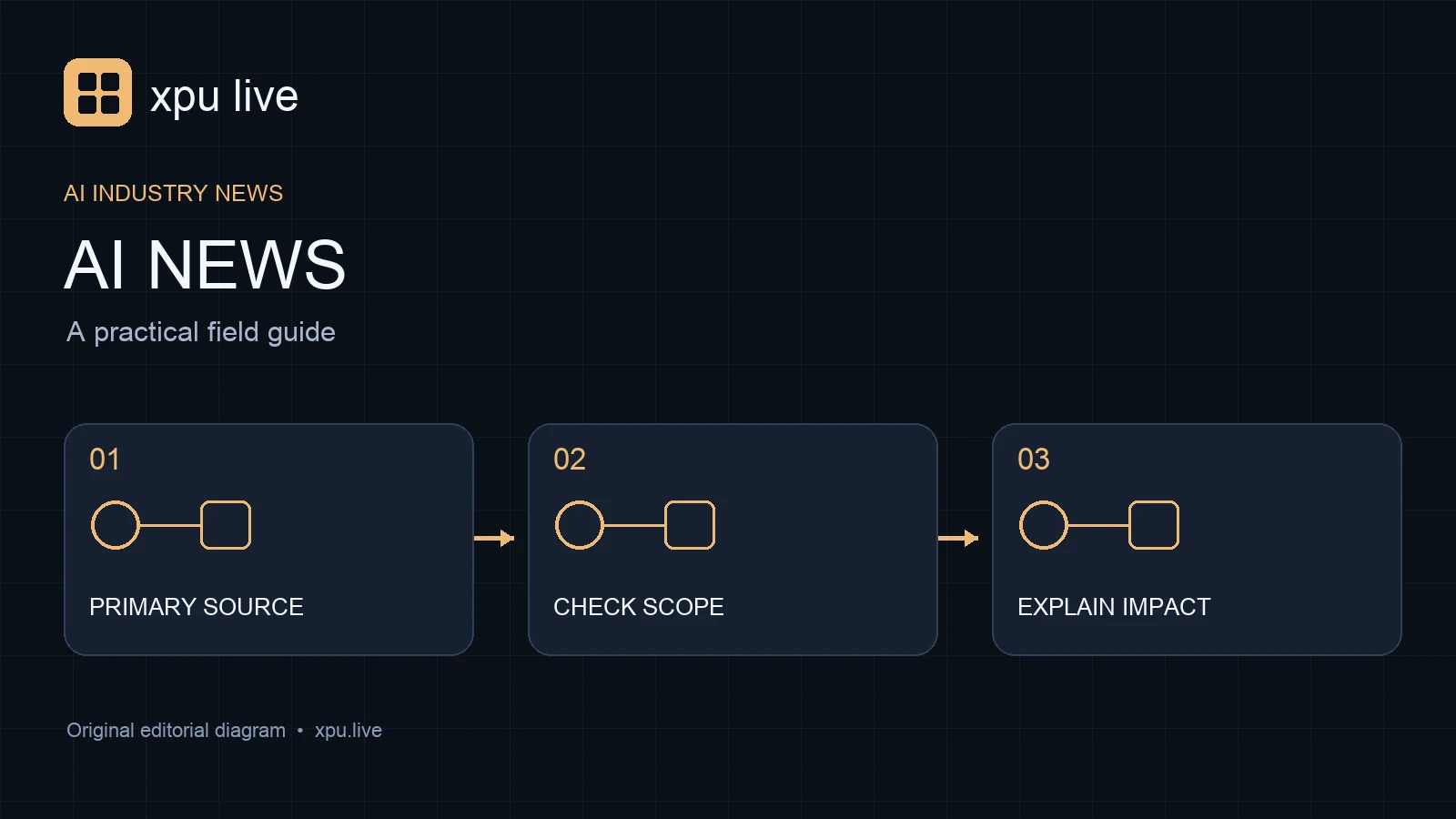
Trace AI news to the original announcement
Start with the organization responsible for the development. Look for a release note, product page, technical report, filing, or official statement. Secondary reporting can add valuable context, but the primary source helps establish the exact claim. Save its URL and publication date before writing the headline or summary.
Check whether the page has been updated since publication. An announcement might later include access details, corrected specifications, or revised timing. Record the version you used. If the original source is unavailable, say what evidence supports the report instead of presenting a social screenshot as equivalent to a complete official statement. Clear sourcing is the foundation of useful AI news.
Separate publication date from event date
A story published today may describe a release from several weeks earlier. Conversely, an announcement today may describe a product expected in the future. Keep those dates separate. Readers need to know whether they can use the product now, join a preview, or wait for a planned launch that has not yet occurred.
Use precise availability language. Announced, preview, limited access, and generally available are different states. Avoid calling a product released merely because an organization described it publicly. The model releases checklist offers a practical way to verify identifiers and account access before treating an announcement as a deployable option.
Define the scope of AI news claims
Identify the product, interface, region, and account type affected. A provider can change a consumer application without changing its developer API. A cloud marketplace can add a model that remains unavailable in another region. An SDK update can add support for a feature without enabling that feature on every account.
The official model release notes provide examples of notices with different product scopes. In your reporting, retain those distinctions. A concise sentence such as this change applies to the developer API tells the reader more than an unqualified statement that the provider has upgraded everything. Scope is often the detail missing from fast-moving headlines.
Verify numerical claims in AI news
Claims about speed, cost, accuracy, or energy use need a baseline and a method. Ask what the new system was compared with, which settings were used, and whether the measurement represents your reader’s workload. A percentage improvement without these details is difficult to interpret and should not become a universal recommendation.
Read the chart notes and technical appendix where available. If a provider reports its own benchmark, identify it as a provider-reported result. If another organization performs the measurement, describe that method too. The AI benchmarks guide explains how settings, tools, concurrency, and scoring can change the comparison. Keep those conditions attached to the claim.
Inspect pricing and access separately
A launch can include published prices without broad account access, or access without a complete public tariff. Verify both. Check the unit, included resources, availability conditions, and whether a rate is standard, discounted, or account-specific. Avoid describing a conditional starting price as the total cost of running an application.
When reporting a price change, compare the same component and tariff before and after the change. Use dated evidence for both values. If the earlier amount cannot be verified, report the current published rate without inventing a historical percentage. AI news becomes more reliable when the article acknowledges which comparison the available evidence actually supports.
Separate AI news facts from analysis
A factual statement describes evidence such as a published feature, specified limit, or verified access state. Analysis explains possible implications. Both can be useful, but the reader should know which is which. Use language such as this could reduce migration work when describing an inference that has not been tested in the reader’s environment.
Do not turn a plausible consequence into a guaranteed outcome. A new accelerator could improve a workload, but application performance still depends on software, memory, and utilization. A lower tariff could reduce a bill, but only if usage and conditions stay comparable. Clearly labeled analysis lets an article remain helpful without borrowing certainty from the announcement it discusses.
Add context without manufacturing a winner
Explain how the development relates to existing products, but compare only dimensions you can verify. A model launch may improve one capability while changing cost or latency. A new provider may offer attractive capacity in a particular region without meeting every organization’s requirements. Present those tradeoffs instead of forcing the story into a best-product ranking.
Link to relevant specifications and comparison pages so readers can inspect the details. The xpu live GPU directory and provider directory can support discovery, while official sources establish the final conditions. Keep the dates visible because a well-sourced comparison can still become outdated when a provider changes its catalog or pricing.
Publish a correction and update process
A news article should have an identifiable author or editorial owner and a visible publication date. If a meaningful correction occurs, update the text and explain what changed. Distinguish a correction of an error from new information that arrived after publication. This helps readers understand whether the original account was wrong or simply incomplete at the time.
Create a short checklist for follow-up. Revisit availability, final specifications, and pricing after a preview becomes a public release. Check important links and retain the original sources. For a fast-moving beat, this maintenance matters as much as writing the first version. AI news should become more useful as evidence improves rather than leaving an outdated launch claim untouched indefinitely.
A reliable news brief structure
Open with the confirmed event and its date. Explain the affected product and access status. Present the important capabilities or changes with source links. Then add pricing conditions, limitations, and a clearly labeled interpretation. Finish with what a reader can verify or test next. This structure answers practical questions without padding the story with unsupported excitement.
Frequently asked questions
Is an official announcement enough to recommend adoption? It establishes what the publisher claims. A deployment recommendation also needs access checks and an evaluation relevant to the reader’s task.
How should an unconfirmed rumor be handled? Do not present it as a confirmed release. Identify the evidence and uncertainty, or wait for information strong enough to support the story.
When should an article be updated? Update it when access, specifications, pricing, or central factual claims change. Make meaningful corrections visible to readers.