NVIDIA / Blackwell
B200
| Provider / plan | Price / GPU-hour | Rental type | Terms & configuration | Last checked | Provider pricing link |
|---|---|---|---|---|---|
| Runpodbest-on-demand | $5.98Updated 2026-11-22 · 15:43 UTCLowest flexible rate | On-demandNo reservation | 1 GPU minimumSee providerView detailsCommunity Cloud: lowest public on-demand GPU-hour list rate among enabled clouds. Not a capacity guarantee; storage/networking extra.
|
2026-11-22Auto-collected | View pricing ↗ |
| ModalGPU Tasks | $6.2496Updated 2026-11-22 · 15:43 UTCCPU/RAM: confirm with provider | ServerlessActive GPU time | 1 GPU minimumSee providerView detailsGPU time only; CPU, RAM, storage, region and non-preemptible surcharges are extra.
|
2026-11-22Auto-collected | View pricing ↗ |
| Vast.aiBest on-demand | $8.1278Updated 2026-11-22 · 15:43 UTC | On-demandNo reservation | 1 GPU minimumTexas, USView detailsObserved marketplace offer, not a provider-wide list rate. Total hourly quote for one GPU with the API default disk allocation; bandwidth and additional storage can cost extra. One cheapest verified available on-demand offer per GPU is selected; availability can change.
|
2026-11-22Auto-collected | View pricing ↗ |



Prices are dated listings, not live availability. Compare minimum GPU counts and commitments. Storage, networking and taxes may add charges; CPU/RAM inclusion depends on the provider and is shown beside each serverless rate.
B200 combines a hardware profile with dated rental offers on xpu live. B200 is a Blackwell data-center accelerator for large-model inference and distributed training. This profile covers the 180 GB HGX configuration. Its large HBM capacity and high memory bandwidth make it a candidate when smaller GPUs require model sharding.
B200 specifications and configuration
The catalog records Blackwell architecture, 180 GB of VRAM, HBM3e memory, SXM form factor, 8000 GB/s memory bandwidth, 1000 W maximum board power. These values describe the documented hardware edition. They do not describe the CPU, system RAM or storage of every cloud machine. Open the Specifications tab for the full field-by-field comparison.
180 GB per GPU in the cited HGX B200 configuration; this is not the memory of an entire eight-GPU server. Power is configurable up to 1,000 W per GPU in that reference platform. Consult the manufacturer specification source when checking the exact edition.
Choosing B200 for your workload
B200 is worth comparing for Large language model serving with large weight and KV-cache footprints; Distributed training on an NVLink-connected HGX platform; Memory-intensive AI workloads that exceed an 80 GB accelerator. Its documented strengths include 180 GB HBM3e per GPU; Up to 8 TB/s local memory bandwidth; Fifth-generation NVLink for supported multi-GPU systems. Match those features to the application you intend to run rather than treating a model name as a performance guarantee.
Before deployment, consider Requires a compatible data-center platform; The provider must expose the required NVLink topology; Use a software image that explicitly supports Blackwell. 70B FP16 weights alone are about 140 GB. Allow additional room for KV cache, activations and the runtime; 141 GB nominal memory is not enough evidence of a practical single-GPU fit. Use quantization or model sharding when needed.
B200 rental prices and total cost
The rental table separates provider, plan, hourly rate and rental type. Compare on-demand capacity with reserved, spot and serverless terms where those options are listed. The lowest displayed number is not necessarily the lowest total bill for your workload.
Check the last-checked date, minimum GPU count, included CPU and RAM, disk charges and network fees. Confirm availability directly with the provider before paying. Marketplace quotes describe individual machines and can disappear; they are not a permanent provider-wide price.
Compare alternatives before renting
Use the GPU explorer to compare memory and architecture, or browse GPU cloud providers. For B200, test the same model, precision, batch size and context length on the proposed instance. Record latency, throughput and total cost so your comparison reflects the actual task.
CHOOSING THIS GPU
Is it right for your workload?
180 GB per GPU in the cited HGX B200 configuration; this is not the memory of an entire eight-GPU server. Power is configurable up to 1,000 W per GPU in that reference platform. The cited NVIDIA public HGX reference does not publish a verified CUDA-core count for this exact profile.
Best suited to
- Large language model serving with large weight and KV-cache footprints
- Distributed training on an NVLink-connected HGX platform
- Memory-intensive AI workloads that exceed an 80 GB accelerator
Strengths
- 180 GB HBM3e per GPU
- Up to 8 TB/s local memory bandwidth
- Fifth-generation NVLink for supported multi-GPU systems
Things to consider
- Requires a compatible data-center platform
- The provider must expose the required NVLink topology
- Use a software image that explicitly supports Blackwell
HARDWARE DETAILS
Inside the GPU
180 GB per GPU in the cited HGX B200 configuration; this is not the memory of an entire eight-GPU server. Power is configurable up to 1,000 W per GPU in that reference platform. The cited NVIDIA public HGX reference does not publish a verified CUDA-core count for this exact profile.
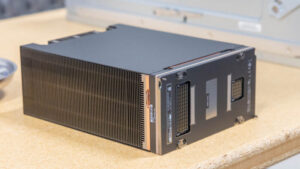
Image: NVIDIA B200 SXM6 single GPU module with heatsink; photo: ServeTheHome / Patrick Kennedy.
- Manufacturer
- NVIDIA
- Architecture
- Blackwell
- VRAM (GB)
- 180
- Memory type
- HBM3e
- Form factor
- SXM
- Memory bandwidth (GB/s)
- 8000
- Maximum board power (W)
- 1000
- Introduction year
- 2024
- CUDA cores
- Not specified in the cited NVIDIA HGX reference
- Tensor cores
- 5th generation
- Ray tracing cores
- Not present; data-center compute accelerator
- CUDA capability
- 10.0
- Memory ECC
- Supported; driver and allocation settings determine enablement
- Host interface
- PCIe Gen5
- GPU interconnect
- 5th generation; up to 1,800 GB/s per GPU (aggregate bidirectional)
- Hardware partitioning (MIG)
- Supported on compatible data-center editions; provider must enable it
- Cooling
- Server platform dependent
Hardware capabilities are not a guarantee of access in a cloud instance. Check the exact edition, GPU allocation and server topology in the rental offer.
MODEL MEMORY
Plan your model size
70B FP16 weights alone are about 140 GB. Allow additional room for KV cache, activations and the runtime; 141 GB nominal memory is not enough evidence of a practical single-GPU fit. Use quantization or model sharding when needed.
| Example model class | Weight format | Raw weights ≈ | Minimum GPUs for weights only |
|---|---|---|---|
| Llama 3.1 8B ↗ | 4-bit | 4 GB | 1Runtime needs more memory |
| Llama 3.1 8B ↗ | FP16 | 16 GB | 1Runtime needs more memory |
| Qwen2.5 14B ↗ | 4-bit | 7 GB | 1Runtime needs more memory |
| Qwen2.5 32B ↗ | 4-bit | 16 GB | 1Runtime needs more memory |
| Llama 3.1 70B ↗ | 4-bit | 35 GB | 1Runtime needs more memory |
| Llama 3.1 70B ↗ | 8-bit | 70 GB | 1Runtime needs more memory |
| Llama 3.1 70B ↗ | FP16 | 140 GB | 1Runtime needs more memory |
Arithmetic lower bound: rounded parameter count × bits per weight ÷ 8, in decimal GB. Excludes quantization metadata, KV cache, activations, CUDA workspaces and training states. Actual model sizes differ from their rounded names. No context length, batch size or concurrency is guaranteed. GPU counts assume supported model sharding and can be higher in practice. Quantized checkpoints and compatible kernels are required for 4-bit/8-bit execution.
SOFTWARE & PERFORMANCE
Before you deploy
Software compatibility
Use an NVIDIA CUDA-enabled framework/container compatible with this GPU and the host driver. Check PyTorch build and inference-engine kernel requirements before deployment. vLLM documents NVIDIA compute capability 7.5+ as a baseline; support for each model and quantization method still needs checking. Select builds that explicitly support Blackwell; a container that runs on Hopper may not include the required kernels.
Measured benchmarks
A reproducible, comparable application benchmark has not yet been recorded for this edition. Peak TFLOPS above are not measured tokens per second or image-generation speed.
Compare tests using the same model, precision, GPU count, engine version, input/output length and batch or concurrency. A provider’s server configuration can change the result.
COMPARE YOUR OPTIONS
Alternatives to consider
BUDGET YOUR RUN
GPU cost estimator
GPU compute only: hourly rate × billable hours × GPU count. CPU, RAM, storage, egress, taxes, billing increments and minimum terms may add charges. Serverless hours mean active GPU task time; spot capacity can be interrupted. Reserved commitments and quote-only offers are excluded from this simple hourly estimator.