NVIDIA / Turing
RTX 2060
No rental offers yet
Published offers will appear here when a provider lists this GPU.
Prices are dated listings, not live availability. Compare minimum GPU counts and commitments. Storage, networking and taxes may add charges; CPU/RAM inclusion depends on the provider and is shown beside each serverless rate.
RTX 2060 is a desktop graphics GPU based on NVIDIA’s Turing architecture. This reference profile records 6 GB of GDDR6 memory and 1920 CUDA cores. Its listed memory bandwidth is 336 GB/s.
Reference configuration: RTX 2060 6 GB GDDR6, 1920 CUDA cores, 336 GB/s and 160 W. The later 12 GB version has 2176 cores and a 185 W reference limit. The provider label does not distinguish them.
Its usable workload size depends on the entire memory budget. Model weights, KV cache, runtime buffers and temporary tensors all consume VRAM. Quantization can reduce weight storage, but it does not guarantee that a model fits or that an inference engine supports the card.
Use the architecture-specific driver and CUDA requirements in the software section. Tensor and ray-tracing capabilities describe hardware features; they do not establish a measured token rate or guarantee support for every precision and quantization kernel.
Rental availability is tracked separately from this hardware profile. If no provider offer is listed, XPU has no verified current rental price for this item. Hardware specifications remain useful for comparing equipment, but they are not a live offer or a promise of availability.
CHOOSING THIS GPU
Is it right for your workload?
Reference configuration: RTX 2060 6 GB GDDR6, 1920 CUDA cores, 336 GB/s and 160 W. The later 12 GB version has 2176 cores and a 185 W reference limit. The provider label does not distinguish them.
Best suited to
- Graphics and CUDA workloads that fit the listed VRAM
- Small quantized-model experiments after checking engine support
- Development workloads where runtime compatibility is verified
Strengths
- 12 GB reference memory capacity
- Turing architecture with an explicit CUDA capability
- Hardware details separated from rental-provider availability
Things to consider
- Installed board edition and usable VRAM need confirmation
- GPU memory also holds KV cache, activations and runtime buffers
- No measured throughput is inferred from theoretical specifications
HARDWARE DETAILS
Inside the GPU
Reference configuration: RTX 2060 6 GB GDDR6, 1920 CUDA cores, 336 GB/s and 160 W. The later 12 GB version has 2176 cores and a 185 W reference limit. The provider label does not distinguish them.
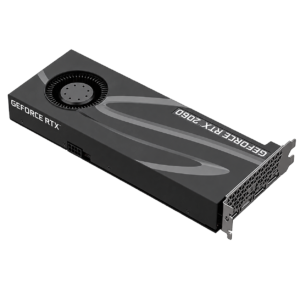
Image: PNY GeForce RTX 2060 6GB Blower; partner/reference board appearance, not a rental-server guarantee.
- Manufacturer
- NVIDIA
- Architecture
- Turing
- VRAM (GB)
- 6
- Memory type
- GDDR6
- Form factor
- PCIe add-in card
- Memory bandwidth (GB/s)
- 336
- Maximum board power (W)
- 160
- Introduction year
- 2019
- CUDA cores
- 1920
- Tensor cores
- 2nd generation
- Ray tracing cores
- 1st generation
- CUDA capability
- 7.5
- Memory ECC
- Not supported on this reference GeForce configuration
- Host interface
- PCIe 3.0 x16
- GPU interconnect
- Not supported
- Hardware partitioning (MIG)
- Not supported
- Cooling
- Active cooling; exact fan and slot layout depend on board partner
Hardware capabilities are not a guarantee of access in a cloud instance. Check the exact edition, GPU allocation and server topology in the rental offer.
MODEL MEMORY
Plan your model size
Estimate weights as parameters multiplied by bytes per parameter, then add runtime buffers and KV cache. For example, 7B weights occupy about 14 GB in FP16, 7 GB in INT8 or 3.5 GB in 4-bit before overhead. This is arithmetic guidance, not a verified fit or speed benchmark for this GPU.
| Example model class | Weight format | Raw weights ≈ | Minimum GPUs for weights only |
|---|---|---|---|
| Llama 3.1 8B ↗ | 4-bit | 4 GB | 1Runtime needs more memory |
| Llama 3.1 8B ↗ | FP16 | 16 GB | 3Runtime needs more memory |
| Qwen2.5 14B ↗ | 4-bit | 7 GB | 2Runtime needs more memory |
| Qwen2.5 32B ↗ | 4-bit | 16 GB | 3Runtime needs more memory |
| Llama 3.1 70B ↗ | 4-bit | 35 GB | 6Runtime needs more memory |
| Llama 3.1 70B ↗ | 8-bit | 70 GB | 12Runtime needs more memory |
| Llama 3.1 70B ↗ | FP16 | 140 GB | 24Runtime needs more memory |
Arithmetic lower bound: rounded parameter count × bits per weight ÷ 8, in decimal GB. Excludes quantization metadata, KV cache, activations, CUDA workspaces and training states. Actual model sizes differ from their rounded names. No context length, batch size or concurrency is guaranteed. GPU counts assume supported model sharding and can be higher in practice. Quantized checkpoints and compatible kernels are required for 4-bit/8-bit execution.
SOFTWARE & PERFORMANCE
Before you deploy
Software compatibility
Use a driver and CUDA-enabled framework build supporting compute capability 7.5. Verify the inference engine and quantization kernels for this architecture; availability of CUDA does not guarantee every model runtime is supported.
Measured benchmarks
A reproducible, comparable application benchmark has not yet been recorded for this edition. Peak TFLOPS above are not measured tokens per second or image-generation speed.
Compare tests using the same model, precision, GPU count, engine version, input/output length and batch or concurrency. A provider’s server configuration can change the result.
COMPARE YOUR OPTIONS
Alternatives to consider
BUDGET YOUR RUN
GPU cost estimator
An eligible hourly price is not recorded. Check the rental terms below for quotes or reserved commitments.